Chapelwaite
'Salem's Lot: A NovelChapelwaite is the Boone ancestral estate and the decisive setting of the embedded history surrounding Jerusalem’s Lot. Set apart by its isolation, grotesque architecture, and buried family secrets, it first appears as a place of solitude and literary possibility before becoming a site of confinement, revelation, and supernatural inheritance. Its rooms, cellar, hidden compartment, and connection to the ruined village turn the house into more than a residence: Chapelwaite is the physical gateway through which an ancient evil reaches the living.
Setting and Appearance
Chapelwaite stands on a large, jutting tract of land near the coast, approximately three miles north of Falmouth and nine miles north of Portland. Its grounds cover about four acres and have reverted to wilderness, with junipers, scrub vines, bushes, and creepers overrunning the old stone walls. The estate’s ornamental features have become grotesque rather than beautiful: imitations of Greek statuary peer through the vegetation as though ready to attack, a summer-house lies nearly buried beneath scarlet sumac, and a distorted sundial occupies what was once a garden.
The house nevertheless possesses a commanding view. From the parlour, Charles Boone can see Chapelwaite Head, the rocks below it, and the Atlantic beyond. A large bay window frames the sea, while an enormous, toad-like secretary stands nearby. This combination of cultivated interior and violent landscape gives Chapelwaite its central visual tension. The house promises a quiet place for writing, yet its view exposes an older and less governable world: granite, ocean, weather, and time. Even the sea’s impact against the rocks is experienced less as ordinary sound than as vibration, making the estate seem physically attuned to forces beyond ordinary perception.
Arrival and Social Isolation
Charles Boone comes to Chapelwaite after the death of his cousin and initially treats the estate as a promising retreat. He imagines beginning the novel he has discussed for years and makes arrangements for deliveries and cleaning women. Calvin McCann remains with him as a practical and dependable companion. The house appears capable of becoming a settled household, but the surrounding community regards residence there as dangerous. A local pulp-logger tells Calvin that anyone who lives at Chapelwaite must either be mad or risk becoming mad, and promises to deliver firewood only in daylight and by the sea road.
That warning establishes Chapelwaite as a socially isolated space before its supernatural history is confirmed. The estate is separated not only from nearby communities but also from ordinary confidence in the rational world. Charles cannot simply carry his fears into Preacher’s Corners, and Calvin refuses to leave him. The house therefore creates a closed circuit: stories enter through letters, rumors, and inherited documents, while the men inside become progressively less able to test their experience against the outside world.
Hidden Architecture and the Jerusalem’s Lot Connection
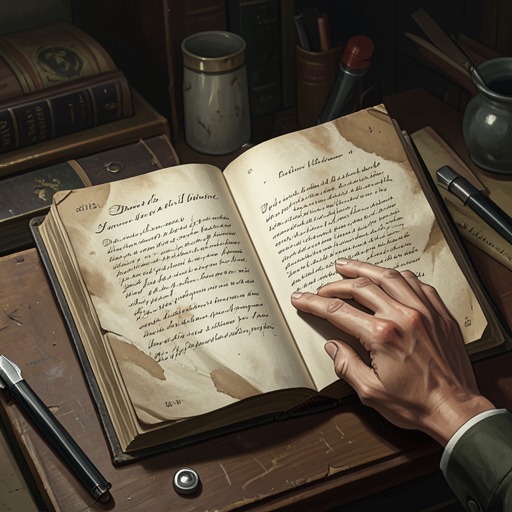
The house conceals a false section of bookcase: behind a square black opening, the books are dummies and a small hiding place has collected decades of dust. Inside lies a yellowed map drawn in thin black strokes. It depicts a village of only a few buildings, including one marked by a steeple and labeled “The Worm That Doth Corrupt.” An arrow points toward Chapelwaite from the northwest. The map transforms the estate from an isolated country house into a directional marker in a larger occult geography, explicitly joining it to Jerusalem’s Lot.
Charles and Calvin use the map to guide an expedition through the woods. They carry a compass, a picnic lunch, and the ancient map of Jerusalem’s Lot, moving through silent stands of pine while the Atlantic pounds against the headlands. After roughly two miles they find an overgrown road and follow it toward the village. The journey outward from Chapelwaite is also a descent into family history: the house has preserved the route to a place that the surrounding world has allowed to become legend.
The cellar makes this buried connection bodily. Its entrance is a trapdoor in the kitchen floor, and opening it releases a foul smell like the odor surrounding the deserted town across the Royal River. The stairs are damaged and dangerous, with a missing riser that could explain how Marcella met her death. At the bottom, a hidden wall opens onto figures in darkness: one has black eyes, a toothless grin, a rotted hand, and a rope burn around its neck; another is a mouldering girl whose head hangs at an impossible angle. Charles escapes only by throwing his candle and then a chair at the apparition. The house’s private underworld is thus not symbolic in any merely abstract sense. It contains bodies, deaths, and an active passage toward the buried evil.
Contamination and Family History
After the cellar encounter, Charles understands Chapelwaite as a possessed and tainted house. He believes that he has awakened a force that has slept in Jerusalem’s Lot for half a century, a force that killed his ancestors and bound them as nosferatu, or the Undead. The phrase “blood calling to blood” gives the estate’s horror a hereditary structure: Chapelwaite does not randomly select its occupants but draws Charles into a drama already written through the Boone family line.
The connection becomes unmistakable when Charles enters the ruined church associated with James Boon. There he sees a corpse-like figure rise from the darkness, its half-skull covered with beetles and its eyes still alive with an inhuman, cosmic emptiness. He recognizes the family resemblance in the ruined face, but not to the Boone relatives whose portraits hang in Chapelwaite’s gallery. The figure is James Boon, remembered as the Keeper of the Worm. Chapelwaite’s gallery and cellar therefore form opposing archives: the gallery preserves respectable lineage in images, while the subterranean spaces return the family’s forbidden history in animated flesh.
Charles concludes that James Boon still exists somewhere beneath the twisted darkness of Jerusalem’s Lot and Chapelwaite, and that the entity associated with him still lives as well. Burning the book has thwarted it temporarily, but other copies remain. In Charles’s account, Chapelwaite is not simply haunted by a past event; it is part of the mechanism by which that past continues to operate. The house is both archive and gateway, preserving the knowledge that summons danger while opening onto the place where the danger survives.
Destruction, Survival, and Narrative Function
Charles finally declares that he is the gateway and the last of the Boone blood, concluding that he must die to break the chain for humanity’s sake. His decision turns Chapelwaite into the site of a failed attempt at containment. The estate has offered shelter, a study, and a view of the sea, but it has also enclosed the heir whose blood gives the ancient force access to the present.
A later account challenges part of Charles’s conclusion. James Robert Boone states that Charles was not the last Boone descendant: Robert Boone had fathered at least two illegitimate children, one of whom died in infancy while the other took the Boone name and settled in Central Falls, Rhode Island. James Robert identifies himself as the final descendant of that branch and publishes the papers after taking up residence in Chapelwaite. This disclosure weakens Charles’s certainty about the genealogy even as it confirms the house’s continuing importance. The documents survive, the ancestral home remains occupied, and the inherited story is passed to another Boone.
The later narrator also questions Charles’s description of the ruined church, finding no evidence of an explosion or enormous damage when Jerusalem’s Lot is rediscovered. The discrepancy leaves Chapelwaite suspended between supernatural testimony, forgery, paranoia, and genuine contamination. Yet the house’s material condition preserves an uneasily mundane remainder: there are enormous rats in the walls, and James Robert concludes that the place urgently needs an exterminator. That closing detail does not dissolve the horror. Instead, it allows Chapelwaite to retain both possibilities at once—a decaying ancestral home that can be explained by neglect and vermin, and a gothic threshold whose hidden rooms have carried the Boone family toward the Worm and the Undead.